Author: Dave Williams; dlwilliams=aristotle=net
There was a rebuilt BOSS 302 harmonic balancer in a box. A rusty-but-new Chinese cast iron 5.0 crankshaft, five bushed BOSS 302 rods, two 289 High Performance rods, a stock 289 rod, and a box of newish Speed-Pro forged pistons. Someone had taken some 351 Cleveland pistons and cut the decks down to make rectangular "domed" BOSS 302 pistons. Then they'd tried to cut snap ring grooves in the wristpin bores, which apparently turned into a disaster. Which didn't stop whoever it was from doing all eight pistons... oh, and one piston was a TRW, 20 grams lighter than the seven Speed-Pros. Topping it off was a late 351W truck flywheel, according to the casting marks.
One look at all this, and I called the other shop to tell them this wasn't going to work. He got with his customer, who was apparently determined to make this random assortment of crap work no matter how much it cost. It cost more than just buying the right freakin' parts to begin with. But I got my money up front, and proceeded with a heartfelt "oy vey!"
 The first order of the day was the connecting rods. They were out of several
different motors, and most had been ground for balance at least once. I
figure there were two different BOSS 302 donors. You can tell the 289 rods
since they don't have the proper rounded reliefs to match the bolt heads.
The first order of the day was the connecting rods. They were out of several
different motors, and most had been ground for balance at least once. I
figure there were two different BOSS 302 donors. You can tell the 289 rods
since they don't have the proper rounded reliefs to match the bolt heads.
All right rods had to be bushed, oil holes drilled, and the 5/16" 289 rod redrilled for 3/8" bolts. The customer didn't want to pay for a set of new bolts, and scraped some grungy used 3/8" bolts up from a mudhole somewhere. Oy vey!
It took some creative grinding to get this sad set of mismatched scrap metal
balanced, plus a spot of weld here and there. It would have been cheaper to
buy a set of aftermarket 5.155" rods, but then they wouldn't be "original BOSS
302 rods." Well, some of them, anyway.
 A "master machinist" did the work on the domes, and the botch job on the snap
ring grooves. The wristpins were used, from some other set of pistons, as
seven of these had never been run. The pins had been pressed out of old
pistons and were galled in spots, and since the bozo didn't want to buy new
wristpins, I had to polish them on the lathe.
A "master machinist" did the work on the domes, and the botch job on the snap
ring grooves. The wristpins were used, from some other set of pistons, as
seven of these had never been run. The pins had been pressed out of old
pistons and were galled in spots, and since the bozo didn't want to buy new
wristpins, I had to polish them on the lathe.
 Blurry view of the domes. They don't look much like "original BOSS 302
pistons" to me. It took a bit of creative drilling and grinding to get the
pistons all the same weight.
Blurry view of the domes. They don't look much like "original BOSS 302
pistons" to me. It took a bit of creative drilling and grinding to get the
pistons all the same weight.
I had to use the rod hone to clean up the wristpin bores where they'd been
mangled.
The only solution I knew of was wristpin buttons, so I priced them as part of the job. This was the interesting part for me, so that's the part I took pictures of.
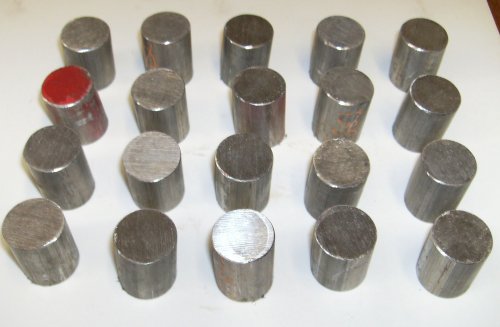 First we saw up a bunch of 7/8" 2024 aluminum round bar. I made 20 pieces
in case I bungled a part.
First we saw up a bunch of 7/8" 2024 aluminum round bar. I made 20 pieces
in case I bungled a part.
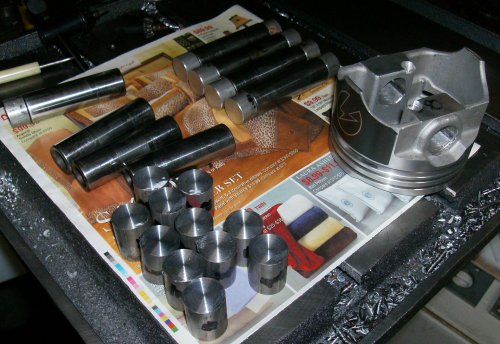 Parts in progress. They had to be faced off, then turned down to slip .600"
into the pin, with about .4" sticking out unsupported. Each button had to be
fitted into each end of each wristpin using a fine file and sandpaper in the
lathe. The pin bores were slightly tapered and varied slightly in inside
diameter.
Parts in progress. They had to be faced off, then turned down to slip .600"
into the pin, with about .4" sticking out unsupported. Each button had to be
fitted into each end of each wristpin using a fine file and sandpaper in the
lathe. The pin bores were slightly tapered and varied slightly in inside
diameter.
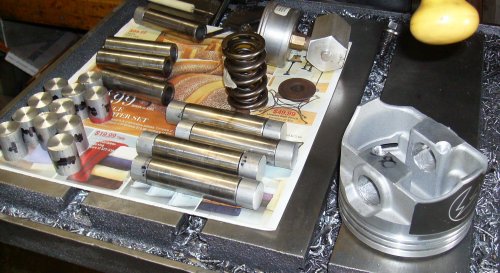 The buttons were fitted to .00025"; with a button at each end, the joints
were air tight. Since they're overhung past the end of the pin quite a bit I
didn't want inertial forces to beat them to death if they moved around, but
they couldn't fit too tightly since they will expand faster than the pin as
things warm up.
The buttons were fitted to .00025"; with a button at each end, the joints
were air tight. Since they're overhung past the end of the pin quite a bit I
didn't want inertial forces to beat them to death if they moved around, but
they couldn't fit too tightly since they will expand faster than the pin as
things warm up.
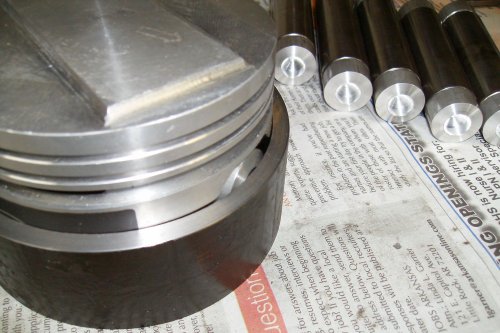
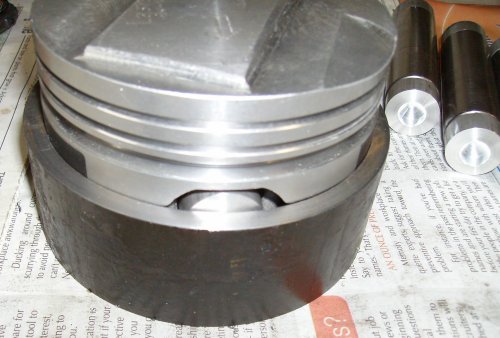 I had to make a 4.040" ID checking ring for the final fitting. The buttons
are then cut to length, one at a time, until they just barely go into the
fixture.
I had to make a 4.040" ID checking ring for the final fitting. The buttons
are then cut to length, one at a time, until they just barely go into the
fixture.
Theoretically you would want a sector of a 2.02" radius, but the curve is so
shallow over 1/4" or so of the button's edge that a flat cut is close enough.
Well, actually it's a very shallow chamfer.
 The pistons had .060" offset wristpins, except for the TRW, which had no offset.
I shaved the buttons until I had .003-.005" side clearance, same as
recommended for a floating pin between snap rings.
The pistons had .060" offset wristpins, except for the TRW, which had no offset.
I shaved the buttons until I had .003-.005" side clearance, same as
recommended for a floating pin between snap rings.
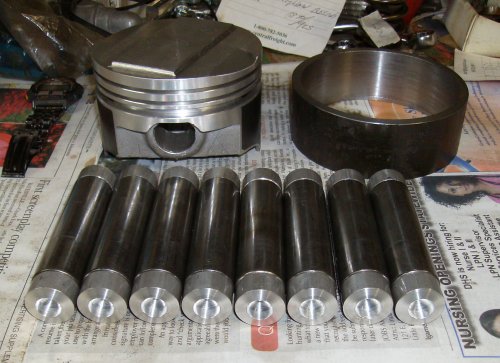 And here we go, all finished! Each pin and button assembly is marked for its
specific piston. 3/8" counterbores take a little useless metal out to save
weight.
And here we go, all finished! Each pin and button assembly is marked for its
specific piston. 3/8" counterbores take a little useless metal out to save
weight.