Author: Dave Williams; dlwilliams=aristotle=net
 One absolutely generic 350 short block. It's balanced, all the clearances are
properly checked, etc., but it's nothing remarkable, other than being a late
'60s or very early '70s casting.
One absolutely generic 350 short block. It's balanced, all the clearances are
properly checked, etc., but it's nothing remarkable, other than being a late
'60s or very early '70s casting.
 Since the engine was originally from a truck, it had screw-in oil plugs at the
fronts of the oil galleries. Not all of them do.
Since the engine was originally from a truck, it had screw-in oil plugs at the
fronts of the oil galleries. Not all of them do.
 Lining up to install the timing chain. I don't have a lot of pictures of this
particular engine.
Lining up to install the timing chain. I don't have a lot of pictures of this
particular engine.
 Torquing the rod bolts.
 Checking oil pickup tube clearance.
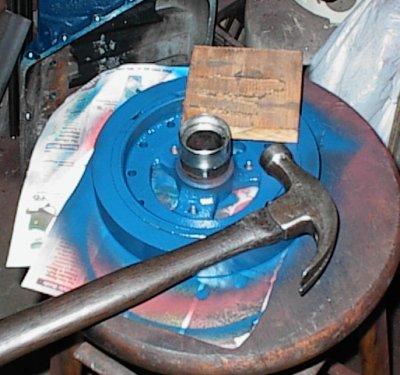 Installing a seal saver on the harmonic balancer.
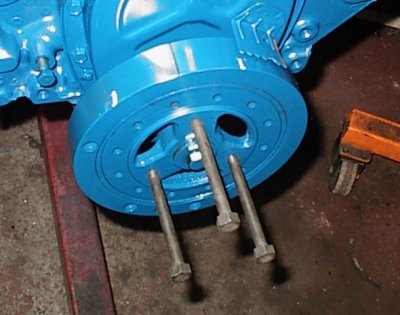 Bolts to turn the engine over with after the balancer was installed. I have a
special tool for this, but I loaned it to someone and forgot who has it.
Bolts to turn the engine over with after the balancer was installed. I have a
special tool for this, but I loaned it to someone and forgot who has it.
 John has the mega-super-truck-duty Turbo 400 with six torque convertor bolts.
He had to redrill the flexplate to fit the convertor. Since I didn't have a
way to check just a flexplate on my balancing machine, I used a lightly oiled
ball bearing on a shaft stuck in the vise. I figured if the flexplate was out
of balance enough to notice, it would turn so the heavy spot was down. The
rollers on the balance machine have such low friction a complete crank
assembly will do that even when the imbalance is too low for the machine to
pick up. The flexplate stayed wherever I put it, so I figured it was close
enough.
John has the mega-super-truck-duty Turbo 400 with six torque convertor bolts.
He had to redrill the flexplate to fit the convertor. Since I didn't have a
way to check just a flexplate on my balancing machine, I used a lightly oiled
ball bearing on a shaft stuck in the vise. I figured if the flexplate was out
of balance enough to notice, it would turn so the heavy spot was down. The
rollers on the balance machine have such low friction a complete crank
assembly will do that even when the imbalance is too low for the machine to
pick up. The flexplate stayed wherever I put it, so I figured it was close
enough.
 These are early '90s Chevrolet 305 "high swirl" heads, with the swirl vane in
the intake port. They have 58cc combustion chambers, which will give 9.2:1
with the dish top pistons you saw in the first image. I swapped the '882 open
chamber heads that came with the core even across for them, and the guy
thought he was getting the better part of the deal. I'm about the only one who
likes these heads, but they've performed excellently on a 383 and a 307 I've
done. You want torque, these are the heads you want.
These are early '90s Chevrolet 305 "high swirl" heads, with the swirl vane in
the intake port. They have 58cc combustion chambers, which will give 9.2:1
with the dish top pistons you saw in the first image. I swapped the '882 open
chamber heads that came with the core even across for them, and the guy
thought he was getting the better part of the deal. I'm about the only one who
likes these heads, but they've performed excellently on a 383 and a 307 I've
done. You want torque, these are the heads you want.
 What I'm trying to show with the penlight is how tall the ports are down
inside. The 283 heads a lot of people use when trying to get the flow
velocity up at low revs are very short inside. These 305 heads are narrower,
but probably twice as tall; the cross-sectional area is much larger than it
looks at first glance.
What I'm trying to show with the penlight is how tall the ports are down
inside. The 283 heads a lot of people use when trying to get the flow
velocity up at low revs are very short inside. These 305 heads are narrower,
but probably twice as tall; the cross-sectional area is much larger than it
looks at first glance.
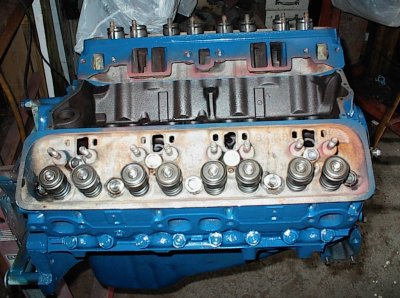 Assembled and torqued long block.
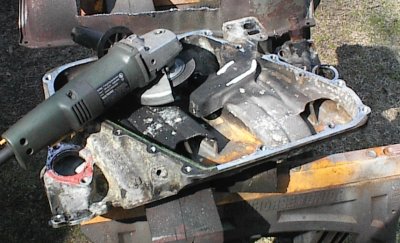 For torque, we want the correct intake manifold. Yes, the good old (unloved)
Chevy Cross-Fire EFI intake was the choice. Again, I've used this part
before, with pleasing success. Here I'm ruining a grinder wheel trying to
remove the EGR dong from the plenum.
For torque, we want the correct intake manifold. Yes, the good old (unloved)
Chevy Cross-Fire EFI intake was the choice. Again, I've used this part
before, with pleasing success. Here I'm ruining a grinder wheel trying to
remove the EGR dong from the plenum.
 Okay, here I'm doing it the correct way, that I should have done in the first
place...
Okay, here I'm doing it the correct way, that I should have done in the first
place...
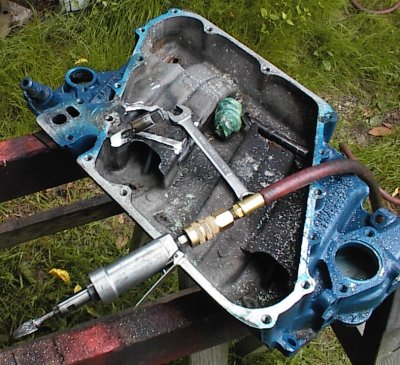 Since this is a pre-'87 intake it has the old-style center bolt pattern. The
high swirl 305 heads have the late bolt pattern. It seems I run into this
problem pretty often...
Since this is a pre-'87 intake it has the old-style center bolt pattern. The
high swirl 305 heads have the late bolt pattern. It seems I run into this
problem pretty often...
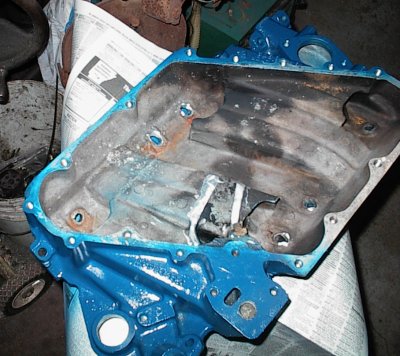 And here are the slots. The bolt heads ride down on one side after you do
this, but it doesn't seem to be a problem. I put a couple of grade-zero flat
washers under each one to spread the load.
And here are the slots. The bolt heads ride down on one side after you do
this, but it doesn't seem to be a problem. I put a couple of grade-zero flat
washers under each one to spread the load.
I also epoxied plugs in the EGR crossover and made a blockoff plate; this was
a non-smog application.
 The gasket set came with early-type intake gaskets, which have large coolant
holes at either end. The late model intake pulls water from all four corners,
and the center exhaust valves will overheat if you use the early gaskets. I
made some shims out of an old Coke can and put bleed holes in them with a paper
punch. You want a trickle of water coming from the back, not a torrent.
The gasket set came with early-type intake gaskets, which have large coolant
holes at either end. The late model intake pulls water from all four corners,
and the center exhaust valves will overheat if you use the early gaskets. I
made some shims out of an old Coke can and put bleed holes in them with a paper
punch. You want a trickle of water coming from the back, not a torrent.
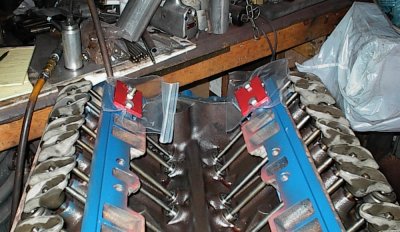 A pair of pressure check plates were dandy for holding everything compressed
while the silicone set up. Plastic bags keep the silicone from sticking to
the plates. Doesn't stick to the bags, either.
A pair of pressure check plates were dandy for holding everything compressed
while the silicone set up. Plastic bags keep the silicone from sticking to
the plates. Doesn't stick to the bags, either.
 Firmly attached blockoff plates.
 Assembled, with late model valve covers, EGR blockoff plate, and ordinary
heater hose nipple.
Assembled, with late model valve covers, EGR blockoff plate, and ordinary
heater hose nipple.
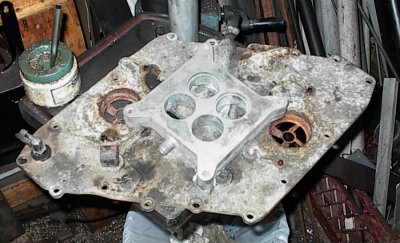 Intake lid with carb spacer so I can mark out where to mill.
 Getting ready to make chips...
 ...and now we're done.
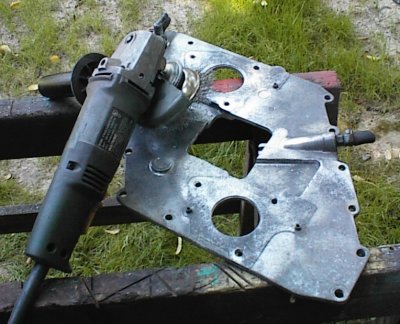 Wire wheeling the grote off. Corrosion, and what looked like dry chemical
fire extinguisher compound, yecch.
Wire wheeling the grote off. Corrosion, and what looked like dry chemical
fire extinguisher compound, yecch.
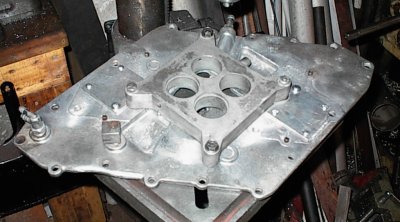 Bolted together, with cover plates over the old throttle body holes. There
are aluminum blocks screwed into the troughs under the carb spacer. The whole
thing got epoxied inside and out to make it airtight.
Bolted together, with cover plates over the old throttle body holes. There
are aluminum blocks screwed into the troughs under the carb spacer. The whole
thing got epoxied inside and out to make it airtight.
============================================================================

     M A X I M U M     O V E R D R I V E     R A C I N G     E N G I N E S

                350 Chevrolet for John

                              completed 06/15/03

     warranty:  If it breaks, you get to keep all the pieces you can find.


                                     *****


        350 Chevrolet, .080 overbore  (364 CID) (5966 cc, 6.0 liters)

        SSI #10388 hydraulic flat tappet cam, "280 degrees"
        214/214 @.050, .443/.443, 110 deg LC

        Chevrolet 305 high swirl center-bolt heads

        Compression:

                pistons 3.06 x .08 dish
                   9.5cc dish
                   1.5cc large chamfer
                   4  cc 4 valve reliefs
                   -----
                   15cc total dish


                 711cc   4.030 x 3.48 bore and stroke
                   9cc   head gasket (.045 x 4.1)
                  58cc   305 head combustion chamber
                   4cc   valve reliefs
                  15cc   piston dish
                 -----
                   797   cc total volume


                   9cc   head gasket (.045 x 4.1)
                  58cc   305 head
                   4cc   valve reliefs
                  15cc   piston dish
                 -----
                  86cc   cc clearance volume


                              797 / 86 = 9.2:1 CR

                                     *****


===========================================================================

block:
        early 350, 2 bolt main
        bore .080, hone #380
        cam bearings Dura-Bond CH-8
        new freeze plugs
        chase all threaded holes

heads:
        high swirl 305 heads
        58cc combustion chambers
        1.84/1.50 valves, 11/32 stems
        rotators on all valves
        vacuum checked valve job
        O-ring and umbrella seals, good to .490 lift
        1.70" valve installed height
        stock 1.5:1 rockers
        chase all threaded holes
        bronze guide liners, .0015"
        stock center-bolt valve covers

rods:
        stock 5.7" large journal forgings
        resized
        bearings .010 Federal Mogul CP-663-P-10
        side clearance: #1      .006"
                        #2      .008"
                        #3      .010"
                        #4      .005"
        assembled height:
        1)      -.030           2)      -.043
        3)      -.033           4)      -.040
        5)      -.048           6)      -.032
        7)      -.040           8)      -.037

pistons:
        Badger castings
        .080 oversize
        .060 pin offset
        3.06 x .075 round dish, 4 reliefs
        fitted at .002-.0025"

rings:
        Perfect Circle 50564CP-.080
                .023                    .021
        1)      .021            2)      .018
                .025/.025               .022/.024

                .021                    .022
        3)      .017            4)      .018
                .021/.022               .030/.025

                .025                    .019
        5)      .023            6)      .017
                .021/.024               .026/.022

                .023                    .021
        7)      .020            8)      .017
                .025/.025               .029/.022

crank:
        stock 350 casting
        mains .020 ACL  SM909-P-20 #2,3,4,5
              .030 Federal #1
        mains   #1      .002    .030
                #2      .0025   .020
                #3      .0015   .020
                #4      .0015   .020
                #5      .002    .020
        balanced
        .005" end play

intake:
        Chevrolet "Cross-Fire" EFI manifold
        four center bolt holes slotted for late model heads
        NOTE: there's no water behind the four slotted holes, just oil.  Fill
              the slots with sealer when replacing intake to make sure you
              don't suck oil up into the plenum.  The soft aluminum washers
              go on these four bolts.
        WARNING: needs late model intake gaskets with restrictors!
                 "1990 half-ton 350 with TBI" will do
        modified lid for Carter AFB
        EGR passages plugged
        EGR stinger in plenum milled out
        steel EGR blockoff plate on EGR valve boss

cam:
        SSI #10388 hydraulic, "280 degrees"
        214/214 @.050, .443/.443, 110 deg LC
        new hydraulic lifters
        Cloyes HyVo timing set
        degreed straight up (no bushings needed)
        stock pushrods

oiling:
        stock capacity oil pump, Melling M55
        new 5/8" pickup tube
        pickup to pan clearance 3/8"
        dipstick tube extension in block

balance:
        758     piston
        176     small end
        55      rings
        51      rod bearing
        51      rod bearing
        403     big end
        403     big end
        -----
        1897g bob weight   949 half

        800 setup/650 spin

        balance .01/.01; limits of machine

misc:
        rotating torque, short block pistons only, 20 ft-lb
        validated TDC mark on harmonic balancer
        primed oil system before it was picked up