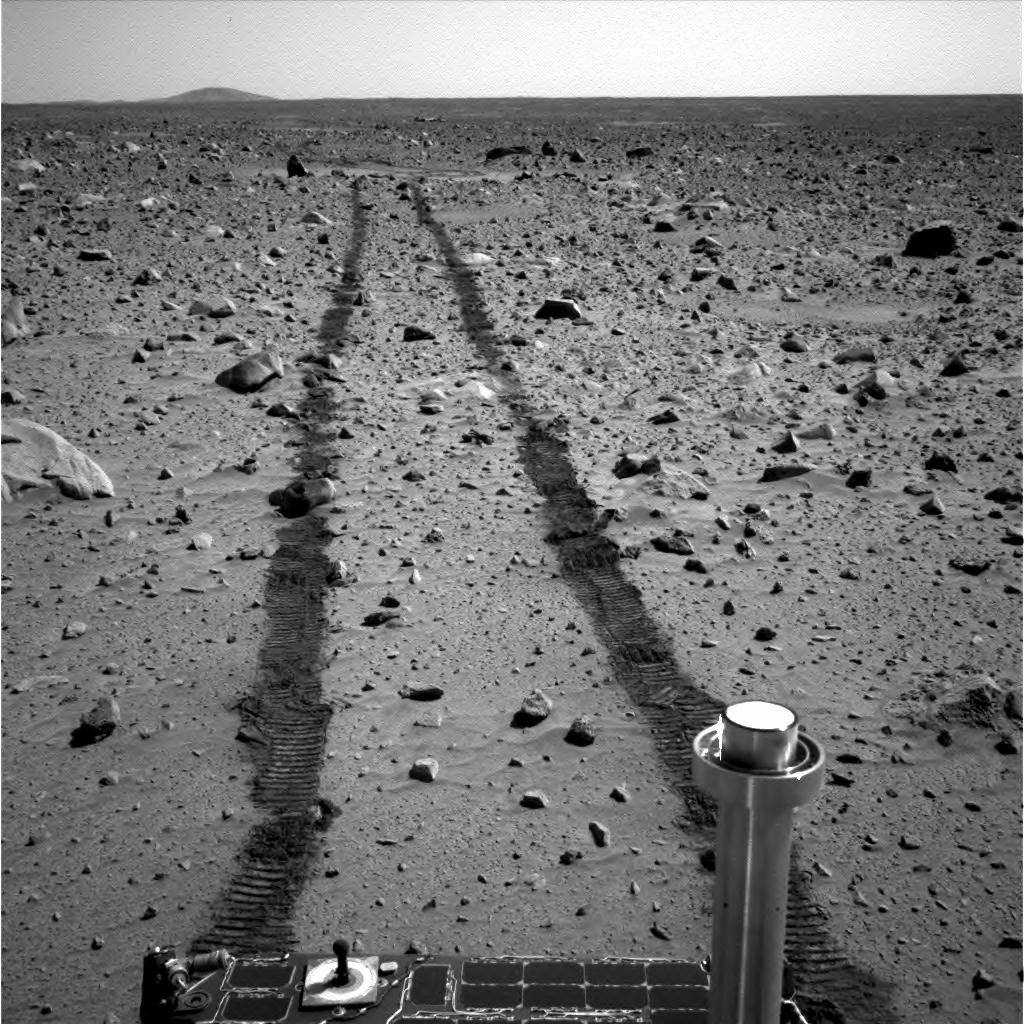
http://planetary.org/mars/images/mer_spirit_navcam_drive_sol61_rear_1024x1024.jpg
It has since gone away, and Google came up with zip on the filename, but I still had it saved to my hard disk.
That's a rearward view from the 'Spirit' Mars rover.
For some reason, those tracks leading off to the horizon just tickle the cockles of my hog, as my friend Kemper would say. Makes me want to lobby for the next rover to carry a can of spray paint to do some graffiti.
"Hey, Homo Sap is here! Where's the beer?"
Lyvim: This is the arena of ideas.  The truth wins.

Dave:  Ah, the blind faith of the innocent...

Lyvim: A little bit of faith got us to the moon.

Dave:  Engineering got us to the moon.  Faith gives you a warm fuzzy.
tannehilln wrote:
> 100 years ago the union was needed to protect you from the "robber barons"
> Like Carnegie and Rockefeller
You can read about the development and implementation of the modern trade union at the original source: "A Communist Manifesto" by Karl Marx. Every modern union has its roots in socialist/communist activism.
Socialism was *big* from the late 1800s on; everybody wanted a piece of the action, from the Mensheviks to the National Socialist German Worker's Party to the Democratic Party in the USA.
> Today the Unions are the robber barons -- screwing their members and
> putting companies out of business -- which really screws their members
Well, we know what happened to the Soviets...
Life was hard in much of Europe around the turn of the previous century. Lenin's blazingly radical political platform tried to provide something for everyone - universal suffrage, equal rights for both sexes and all races under the law, codification of all laws and rule of law, breaking up the huge financial trusts, inheritance taxes to hinder the development of a monetary superclass; a 50 hour work week, overtime, a government-backed universal retirement plan, some sort of public assistance for the disabled or indigent, restraint of the activities of the police, the right to collectively bargain with management, free schools for children...
The Bolsheviks took power in 1917, and Lenin promptly dropped all those promises like a hot rock, and the regime of the tsars continued, though with new management... he was a politician, after all. But almost everything Lenin promised, was an ordinary fact of life in the United States by the 1930s.
The ironic part of all this is, the majority of those reforms were proposed and pushed by Communist agents and followers over here, via the unions and political action groups. And they mostly got what they were agitating for.
Politics is about carrots and sticks. But, in the twisted way things work out, we got the carrot, and the Soviets got the shaft.
I have a small bust of Lenin on the shelf by my monitor. Vladimir Ilych has been very good to me...
The place went dead silent for a second, and then there was Felix's loud voice: "Wow, now that's fresh!"
By preference, I'll go by Wendy's and grab one of their 99 cent bacon cheeseburgers and a 99 cent Coke. Occasionally I'll splurge for a 99 cent order of fries. Total: $2.25 to $3.40, depending on the tax wherever I've stopped.
Last night I splurged on a "Baconator" combo. It turned out to be a standard Wendy's double cheeseburger with a few strips of bacon on top. I took the default configuration, which appeared to have ketchup as the only condiment. I don't think I've eaten a hamburger with ketchup in close to 30 years.
It was a decent hamburger. The indecent part was the price - $6.95. By comparison, my preferred spicy chicken combo was only $5.65. The extra $1.90 apparently covers their marketing blitz. My advice: order two or three of the 99 cent bacon cheeseburgers and forget the Baconator thing.
This is an article on how to mold your own dashboard panels. You could do a complete dashboard, or just a gauge holder. The example is an iPod dock. Having observed the price of replacement dash covers for some antique cars is over $500, and gauge pods for non-popular cars aren't even available, this is a really nifty idea.
Later, when visiting her family down in Grenada, she was trying to explain Oklahoma to her sister. "It's... like the ocean. It just goes on forever."
It was the first time she'd ever seen open country. Grenada is small and mountainous. Then she lived in Montreal, then in Memphis, without traveling anywhere else, much. The idea that there were places where people weren't packed in like rabbits in a hutch astonished her.
I'd seen a lot of commentary about this one on the 'net, all about how "violent" it was. I didn't think it was particularly violent, at least compared to the slasher movies AB likes, or the Chinese chop-socky I've somehow become addicted to.
The first thing you need to know is that "Kill Bill" and "Kill Bill 2" are one movie split across two releases. The first one stops well short of resolution, and the second one picks up where the first one ends. So one without the other isn't going to be worth much.
Excellent sharp camera work, stable Dave-compatible camera angles, not too much tricky special defects. Reasonable plot for a movie of its type. Lots of flashback stuff, which I don't care for all that much, but acceptable. Interesting music selection; mostly '60s pop or imitations thereof.
Unfortunately, I wasn't sure if I was watching a really dumbed-down revenge story or a comedy that sailed so far over my head I missed the whole point. I'm still not sure what the movie was supposed to be; there were some funny-to-me things in scenes that were apparently supposed to be serious. Many of the characters seemed to be spoofing characters from other movies. I dunno. Maybe it's that "Tarantino thing" I've read about.
Lots and lots of bloody fight scenes. I lose interest in that sort of thing after the first few minutes, but if you like extensively choreographed fighting, you'll be in heaven. About a quarter of the movie takes place in Japanese. Since my command of Japanese stops at "empitsu desu ka" I would have appreciated English subtitles.
Since I glazed over during the fight scenes and the long Japanese language sequences, I felt the movie had a bad case of the slows. Chopping it down to two hours or ninety minutes would help it a lot.
http://developer.apple.com/documentation
...for those who keep saying "but OS X isn't BSD!"
Darwin (FreeBSD) is the kernel. Instead of using the X Window system, Apple uses "Quartz" as a window manager. Darwin and Quartz together make up the "OS X" product... but according to Apple's web site, you don't have to run Quartz. You can run X if you want; wherupon OS X magically becomes "Unix." Apple even provides X for you.
Okay.
According to Apple, "the Mac OS X native windowing and display subsystem, Quartz, is based on the Portable Document Format (PDF). Quartz consists of a lightweight window server as well as a graphics rendering library for two-dimensional shapes. The window server features device-independent color and pixel depth, layered compositing, and buffered windows. The rendering model is PDF based."
Wonderful. PDF is about as desirable as colon cancer, so let's turn it into a window manager... at least Sun's "Display PostScript" made a demented kind of sense, back in the 1980s... and yes, I know there's "PostScript" somewhere in the PDF spec, whatever that is today.
What I really wanted to do was to download a copy of Darwin to set up in VMware, just to play with. But all I found was http://www.opensource.apple.com/darwinsource/10.4.9.x86/ which is just a long list of files to download. "Some assembly required." I'm sure someone, somewhere has some build scripts. Maybe someday I'll get the urge to go looking for them.
I moseyed over to freebsd.org and did a search on "darwin", but all it returned was a few press releases, the last dated 2004.
Googling "darwin download iso" got a hit on Apple's web site for a downloadable version, but it's a PowerPC binary from 2002. Hm.
The Akkadians predated the Egyptians; the epic was written somewhere around five thousand years ago, at the dawn of known human civilization. They would surely have been astonished that anyone would deliberately dig out ancient cities to learn about their cultures; before the Germans and English started in the early 1800s, nobody had any use for such knowledge, even of the classical Greeks or Romans. Plenty to do already, who cares about dead wogs anyway?
Five thousand years. Close enough to forever... using technology they could not have imagined, I can pluck it from the networked aether, and have the voices of the djinni read it to me.
And who claims there is no such thing as progress?
Back 30-odd years ago, I wanted a private pilot's license, until I realized the expense of keeping current and ownership or rental of a plane (and its mandatory maintenance) would take all the fun out, even assuming I could afford it.
Back 20-odd years ago, I had the hots to build an ultralight; I could fly one without all the bureaucratic BS. I was at the point of collecting materials for it when I found out a whole lot of things I hadn't known before, just in time.
You look up into the air, you see air, or maybe clouds. When a pilot looks up, all he sees is an interlocking maze of regulated traffic corridors, no-fly zones, approach paths, and so forth. You can fly an ultralight anywhere you want, as long as you stay out of prohibited airspace. Unfortunately, for most suburban and many rural areas, *all* airspace is prohibited to ultralights. My dream of flying coast to coast by ultralight died a horrible death. With a hundred pounds of charts and a snotload of navigation equipment, I *might* have been able to zigzag around enough to stay out of trouble, but the entire trip would be spent running back and forth against the invisible zones marked off by the FAA. Screw it.
The point of the story is, there are often looming masses of law festering behind even ordinary things.
Wow. 1988 might as well have been 1960; maybe I've been infected by James Lileks' habit of looking at the backgrounds instead of what the director wants me to look at. A whole lot has changed since 1988...
Over thirteen-odd years, I'd remembered the movie as okay. Turns out, it's a *d-mned* good movie. I'd remembered it was a comedy; they played a few scenes for yucks, but it's a serious cop movie. And I'd forgotten that a lot of it takes place in Russian, with English subtitles. My Russian stops at less than a dozen words, but there are enough portmanteau words for me to know that what they're saying and what's subtitled isn't precisely the same thing; there's probably something amusing there, if the viewer spoke Russian.
The squirrels always want to sit through the credits; I noticed that they shot parts on location in Moscow and in Budapest. I suspect the broad general shots were in Moscow, and they used Budapest for the action scenes. I don't think the Soviets would have much liked an American film crew's antics in Moscow...
The movie flashes "Moscow" at the bottom for most of the cuts to the USSR; however, the Chicago police thought Danko was from Kiev, and Danko said it himself at least once. I'm not sure if I'm missing something there. Also, a couple of times people made "KGB" comments, at least twice in the USSR scenes... but Danko was GRU, or Soviet police. This might have been just a Soviet subtlety; the KGB never trusted the GRU, and the GRU was infested with KGB doubles and informers to the point where most Soviets treated it as an arm of the KGB; it was considered an insult to refer to a GRU officer as "KGB."
In an even stranger fit of dementia, they have painted the lines in the correct stop-line place at the end of Main Street, which tees into another road... but traffic coming that way has right of way, does not stop. I've seen three or four minor bumper-thumpers where someone saw the lines, stabbed the brakes, and looked around for a red light that wasn't there.
This is merely the latest in the bizarre antics of the city street department. Either they're actively trying to cause wrecks, or they're on serious drugs. I'm holding out for serious drugs; nothing else could account for the new Main Street bridge, which is eight feet out of alignment with the street; traffic has to zag into adjacent lanes to traverse it. I'll take some pictures when I think of it.
A lot of places *used to be* Campbell-Hausfeld dealers around here. Six months to a year ago, they all dropped it. I finally found a place in North Little Rock that sold gas pump equipment; they had some C-H head gaskets in stock, from when the used to be a dealer.
I bought two. The homemade ones just cook hard and blow out.
The O-ring in the valve chest had carbonized, and I needed a new one. Back when we had some real auto parts stores, a few of them had the Parker-Hannefin O-ring kits where the material came on a big spool, they cut off what they needed, and there was a little fixture and adhesive that would make up any O-ring you needed, right on the spot. I found a couple of places that still remembered them, but nobody had one or knew where one could be found. The gas pump place could get them, but it would take three weeks. I hit several hydraulic shops, then found a place called "Little Rock Rubber & Equipment" a little over thirty miles away, that had some 1/16" O-rings in stock, that I could cut down and glue together. $30 in gas, a full day of time, for $8 worth of parts - but I needed compressed air to run the rod heater, because I have an engine that has to leave tomorrow so I can pay the bills.
I'm going to try to mail-order some spares from Campbell-Hausfeld. The story I got from the ex-dealers - ranging from lawnmower-repair shops to NAPA to O'Reilly's to industrial equipment dealers - is that C-H simply became too much hassle to deal with. At least six different places told me they dropped C-H because they'd outsourced their entire parts and service departments to someplace where they don't speak English, and it was no longer possible to actually order anything from them. The only C-H parts in central Arkansas are what's hanging on the wall at Tractor Supply Company - belts, air filters, and some other doodads - and TSC isn't interested in doing special orders.
I hope C-H is saving a bunch of money by outsourcing, because their entire sales and service network has folded up and blown away, at least around here.
Clipped from Lileks' article:
"Why the fury? These kids have computers that permit them to range the world, soak up vast amounts of information, sample every point of view, and they end up as stupid and intolerant as a medieval serf who never traveled five miles from the thatched hut where he was whelped. Perhaps the problem isn't insufficient exposure to opposite views, but too much of it: when you realize that everyone else believes strongly in something you can't understand, you cling desperately to what you know."
-and-
"In fact, you don't need ideas at all. You just need the keyboard commands to bring up someone else's ideas on your screen."
These two comments pretty well sum up the reason the Web hasn't, and probably won't, become the new Information Revolution. Mike O'Brien, in his "Ask Mr. Protocol" column in Sun Times a few years ago, commented that a large number of people will never be able to function adequately online, no matter how much Federal assistance and funding is put out to give the disadvantaged masses equal access... because there's a sharp limit to how much you can accomplish by randomly clicking on pictures; sooner or later you have to read and write, and for a whole lot of people - including college graduates in various fields - written communication is alien and awkward.
"Infamy," however, is not very readable. Much of it doesn't make good sense, though it goes into ridiculous detail on things of little relevance. Then it skips over big things, or at least things I expected him to cover.
The first I ever read of the messaging screwup, where Kimmel and Short were not informed of the impending attack, was in David Kahn's "The Codebreakers," which described Pearl from the standpoint of the cryptographers involved. Most of the stuff I've read about Pearl since has more or less agreed with Kahn - that it was a long chain of incompetence, assholes, and screwups, rather than any particular plot to entice the Japanese to attack.
Toland's foreward talks about how he will expose Roosevelt's plot and coverup, but despite all the shucking and jiving, he never even comes up with a plausible scenario. He also undermines his own credibility by dividing all issues up along Republican and Democrat party lines, by introducing information from "secret" sources identified only by code letters, etc. And even then, he doesn't make a plausible case. Much of the book reads like notes, not a completed text.
I'm not a Roosevelt fan, but I find it hard to believe a conspiracy of that size could be hidden successfully. On the other hand, Kahn's chain of incompetence seems reasonably well documented.
Anyway, whichever way you think Pearl happened, you won't find much to support your views either way with this book. It was a waste of wood pulp.
The other day I noticed The Go-Gos' "We Got The Beat" uses the melody of whatsisname's "Mercury Blues".
The whole thing bothered me. A lot happened; too much to fit into a single three episode story arc, which meant there was some serious telescoping and skipping. Enough that big chunks didn't make a lot of sense unless you filled in your own blanks. The Doctor and Martha zoom along to the year 100-trillion, which gave me a little problem to start with. They meet some humans who are trying to escape a dying planet to go to "utopia" to avoid the end of the universe. These humans are being helped by the Master, who is working his butt off, disguised as a human. He is outed as himself, regenerates (problems here, since he'd already used them all up when he stole the Keeper of Traken's body long ago) and escapes in the TARDIS, which is damaged so it can only jaunt between 2005-ish and 100-trillion. We then find out the Master has orbited a bunch of mind-control devices to help get himself elected as Prime Minister. He then kills his advisors and calls in the "toklaveen", who turn out to be the humans he was helping to escape in 100-trillion, who have been heavily cyborged into giant-sized versions of the ball from Phantasm. Ho-hum, more human cyborgs, just like the Cybermen and Daleks.
Anyway, the Master meets with the President of the USA aboard a US carrier... which is a flying platform that looks remarkably like Cloudbase from Captain Scarlet. So that 2007 isn't the same as our 2007, though nothing more was said about it.
The Master laughs a lot; according to Russel P. Davies in the Confidential episodes, this indicates he is "insane" and "evil." He's having great fun. He kills the cabinet, a bunch of people on the carrier, and 10% of Earth's population, which is seriously out of character - the Master always wanted to rule, not to kill. But we keep being told he's going crazy, which is a valid defense in the USA, anyway.
Meanwhile, he's saved the entire remnant of the human race from extinction. Maybe they didn't like being cyborged into toklaveen, but I'm sure there wasn't a hell of a lot to work with at the end of the universe. Then he brought them back a hundred trillion years, and put them to work building a fleet of warships to kick off a human empire to rule all the universe until the end of time, with him in control. Well, somebody has to be in control, and it looked like he'd earned it.
Of course, his plans are foiled by the Doctor and Martha, and he dies at the end.
I started getting antsy partway through the first episode; as the third unwound, my "WTF!?" meter kept pegging. I know I haven't done a good job of expressing my objections to the arc here, but it doesn't make any freakin' sense.
I'll revisit this subject later, when I watch them again. However, my first take is that Davies just completely lost control of what he was doing and gorked the whole thing up.
The first engine came out when the camshaft at its bearings. The cam was new, but had rusted while in storage. I'd polished the lobes and bearing journals and stuck it in. Ordinarily I would have tossed it, but that engines was being built to a hard budget to compete in the Grassroots Motorsports $2004 Challenge, and the cam was free... there was some mild pitting on the bearing journals, and I didn't expect any problems. However, the cam sank into the cam bearings, and that was the end of that. Cam bearings are very soft and quite heavily loaded. Oddly, the pits on the lobes didn't hurt a thing. It was a "learning experience."
I stole the cam out of the fancy motor, which is a Sig Erson RV35, 218/224 on a 112, with fairly aggressive lobes, installed it straight up. The old Melling 230/230-110 cam was great, as car as I was concerned, and the engine was very crisp, surprising for such a relatively large cam. The Sig is more appropriate for the car, though.
While the engine was apart I noticed signs of piston-to-head contact. I was using the slightly-longer 289 rods, which pushed the pistons out of the block .025". With a .043" gasket that left .022",which was pretty tight, but I'd talked to several people who had done it who claimed no problems.
They probably didn't have any problems; replacement pistons vary quite a bit in their compression hight, which is the distance from the pin centerline to the top of the piston. This particular combination didn't work. So I milled the tops of the pistons down for "zero deck", flush with the top of the block.
Even with a tune-up and fresh fuel, the smaller cam and lower CR/opened quench isn't as snappy as the original setup. I tend to think it's due to the quench. Conventional wisdom is that the tighter the quench, the better the burn, and I expect that's true.
When I went to work in a machine shop, I noticed a lot of my fellow workers had great difficulty reading blueprints. They'd pick the paper up, tilt it at odd angles, and squint a lot. Most of them had been to some sort of training or schooling; I figured they'd skipped the classes for reading blueprints. More than once, I not only saw someone have trouble reading a print, but they failed to recognize the print was of a part that was sitting right on the bench in front of them.
The endless 2D vs 3D wars on the 'net have finally led me to believe that a majority of people simply can't see something in 2D and visualize it in 3D, and vice versa.
It has also become tediously obvious that no amount of CAD software will make a noob into an instant draftsman. And if I could find the guy who thought up "auto-dimensioning", I'd fix him so he wouldn't pass his genetic heritage on.
I'm also appalled at how many publishers are using absolutely horrible "CAD" drawings for illustrations. The utter cheesiness reflects poorly on the publisher, the author, and it's enough to make me suspect the worth of the text it's supposedly illustrating. If they had a scan of a hand drawing on a napkin with a ballpoint pen, it'd be better than the "CAD" illustrations. Blech!
The Merck is primarily on medical diagnostics, and it's the basic medical book from my "list of books to restart civilization" list, as I mentioned last month. I try to be aware of the history and provenance of things, driving home, I realized that, for the price of a Coke, I now owned a piece of history.
Medicine probably goes back to the Cro-Magnon, but the first physician whose name has come down through history is Imhotep, who served the pharaohs of Egypt somewhere around 2650 BC. Hippocrates and Aesculapius referenced Imhotep, which means modern Western medicine goes back in a fairly continuous chain for 4,655 years before we lose it in the mists of time.
As with almost everything else, 99.99% of all we know of medicine was discovered or invented in the last two hundred years, but it all started from Imhotep's notes on pieces of papyrus.
Amazon lists a brand new copy for only US$65; that's probably with a 500% markup from the publisher's cost, but even so, 500 years ago only a wealthy man or a small community could have purchased such a hefty volume. Johannes Gutenberg gets credited with the printing press, but while that's true, it's not generally realized he was also the father of mass production. And Gutenberg's inventions wrecked the social, religious, and political structures of Europe over the following two or three hundred years, something I'll write about later.
Just remember next time they stuff you in the MRI tube or shoot your veins full of radioactive isotopes, "modern" medicine has deep roots.
 First World - high tech nations with developed natural resources
    (USA, most of Europe)

 Second World - low/medium tech nations with undeveloped natural resources
    (Mexico, most of South America, Africa, India)

 Third World - no tech, no resources
    (no pot to piss in and no window to throw it out of -
    most of the smaller islands, most of the 'stans, etc.)
High tech/low resource countries like Japan apparently had no place in that scheme, or medium tech/high resource countries like Canada.
In modern US media terminology, "Third World" has come to mean simply "poor." So even though the original usage lacked precision, the modern usage is virtually meaningless; another example of the English language's fall from a tool of precision to a blunt club.
FIRST, we kill all the barking-head TV "news personalities." THEN we kill all the lawyers...
ARGH!
It will be two weeks before I can make another attempt to get to the track. In the meantime, I need to put fresh brakes on the station wagon, wire the controller for the trailer brakes, and put the new transmission mount in. With the work schedule I've had this year, a lot of things have slid off the schedule.
I managed to get brake fluid on my watch. It has happened before; I wiped it off, no problem. This time I was busy and didn't get around to cleaning it until later. It pretty much destroyed the crystal. It didn't turn white; it's crazed and cracked, and looks like a piece of safety glass someone whacked with a hammer.
Locking the house and taking the keys out of the cars would have been sufficient from my point of view; I think the surveillance system is a bit over the top.
I'll also have to replace the trailer plug. I have a fancy steel bracket I made on the milling machine, bolted to the bumper, with two different trailer plug receptacles. A few weeks ago I noticed one was missing. The corners were still attached to the bracket with their stainless steel screws, but the receptacle itself was gone and the wires had been cut. I've had stuff stolen before, but this was weird. If they were going to steal it, why break the mounting tabs off? Then again, if thieves were very smart, they would be doing something else...
I'd been driving the car around the neighbood while working on it. I zipped down to AutoZone to get some new wiper blades, then to the gas station, then off to Lonoke County to visit my Dad. On the way, it quit and coasted to the side of the road. I noticed the fuel pressure gauge was reading zero, so I popped the cover off the fuse block and wiggled all the fuses. Bingo, we have fuel pressure again, and off to Dad's.
On the way back, the car quit again. I figured the pump was crapping out; I bought it in, oh, maybe 1988. But I could still hear it buzz when I turned the key. Hmm. I was sitting there waiting for it to cool off a bit when I had a thought. I unlocked the fuel flap, twisted the cap, and the tank went "FOCK!" as it inhaled a big gulp of air. Twisted the key in the ignition, and in a few seconds there was fuel pressure.
Not too bad for a shakedown run. The left front tire is holding air, but it's so badly out of round I can't go much over 45mph without blurring my eyeballs. I'll get a new tire shortly.
The old C4 is shifting a bit better, but still late. I need to check the vacuum line to make sure it's not crimped. When I first got it fired back up it wouldn't go into gear at all; "morning sickness" is a characteristic of C4s that sit a lot. When it does shift it barks the tires. I probably need to yank the valve body and give it a disassembly and cleaning, but for right now it's okay.
I flushed the rear brakes Saturday when I pulled the drums off and wire-wheeled the rust out. I'd done the front brakes last year, but I need to flush them again.
Meanwhile, it doesn't get hot, or make funny noises, and it seems to have adequate power. That's the "recycled parts" 302 I put together for the Grassroots Motorsports rules.
It really, *really* needs a Locker, or a Torsen, or even a spool... 2500 pounds, 3.91 gears, and treadwear-400 185R-13 tires are downright embarrassing when you try to pull away from a stop sign.
I presume it's trying to sell *something*, like the occasional mystery signs that pop up with what are apparently product names or logos, giving me no clue as to what they might be. Since I unplugged from the vidiot world I'm used to being out of step with the Toob.
However, whatever it is they're selling, unless Winnie is suddenly the darling of Prime Time TV, there might be a dozen other in the LR metro area who could successfully identify Winston Churchill by his face... and this was not one of the two or three most-common pictures you see of him; it's a poor angle, and it was either a really bad day, or done long after the war.
"DaveWorld. Intersecting many realities, at home in none."
I walked 3 miles back home, temperate 98 Fahrenheit. I figured the filter between the tank and the pump was stopped up. If you let it sit a while the crud drops away and lets some fuel through, so I drove the Malibu back to give it a try. Oops, I'd changed out of my good pants because I'd planned to bring the trailer, and the keys were in them. Back to the house, get the keys, it fires right up. I watched the fuel pressure sag slowly all the way back, right at 2 PSI when I pulled into the yard.
Looks like it's time for a new filter. For whatever strange reason, the strainer in the tank seldom clogs, but I can pull the tank if I have to. When the B2000 sat for five years it took half a dozen filters before it got all the crud. I'd rather feed filters to it then pull the tank.
AB got home shortly after. We went to pick up the Malibu, then on to Western Sizzlin for a buffet dinner. She likes old-people restaurants for some reason. I had chicken strips and fried potatoes, and was feeling sick before I made it out of the place. I am now certain they are putting something in the food. The chicken strips were utterly bland, but the fried potatoes could have been laced with MSG; it's hard to tell in some foods, and I'm allergic to MSG. I was pretty miserable and went to bed early. And to think I paid money for it all...
> Of course Americans don't need speed limits because they are so
> intelligent that they can individually decide for themselves what
> is a safe speed to drive at.
That, and we're all illiterate anyway, so we can't read the road signs. So we just drive as fast as we want all the time, occasionally being stopped for a chat by the nice men in the black uniforms...
> This intelligence is self evident.  When they are free to choose
> what sort of vehicle to buy to drive in the city they prefer a 4WD
> off road vehicle weighing more than two tons.
Drive in any largeish American city, and you'd run down to the car lot looking for something big enough that you need a step hanging under the cab just to get in.
Streets in many urban areas look like Berlin in 1945. Signal lights and signage are random, often poorly placed, and sometimes simply incorrect. Driver training is practically nonexistent, and written tests now concentrate almost entirely on memorizing the penalties for DWI and drugs. (I let my motorcycle endorsement lapse once, and had to re-test. I failed the exam, which consisted *entirely* of alcohol and drug related questions, with no "rules of the road" questions of any kind!) Vehicles are either heavily insured, in which case the drivers would welcome a wreck just to get a new car, or uninsured, in which case the drivers are looking for a nice cat to hit so they can file a personal injury lawsuit. People regularly park by slamming their bumpers into the cars ahead and behind of them, and most of them think nothing about putting a nice dent in your car with their door. When in motion, they're either drunk, stoned, talking on their cellular phone, watching their on-dash DVD player, playing with the radio, drinking or eating, changing diapers, digging through stuff on the floor, or some combination of the above.
But, hey, it's home...
It's funny how many of those old shorts and newsreels were corporate propaganda, and the rest were government propaganda. Most of what I've been snagging has come from the Prelinger Archive.
Mostly, I'm agog at how different the world was back then. There's a (silent) movie there, about how to use a rotary dial phone. Why did they need a 20-minute movie about dialing a phone? Because it was new-fangled stuff; before then, you picked up the microphone and its stand, and you told the operator who you wanted to talk to.
Actually, I bet there are just as many Americans in 2007 who would be baffled by a rotary dial phone. I remember learning how to use one as a kid, and how you had to pull the (very stiff) wheel all the way over to the finger stop, each and every time. If you didn't quite make it, you'd wind up talking to a wrong number.
In the beginning was Multics, which was funded with lots of money from IBM, Honeywell, Burroughs, and other computer manufacturers, plus some from the US government. Multics begat Unix, which was developed by AT&T, otherwise known as "the phone company" in those pre-breakup days. The State of California, through UC Berkeley, also put a lot of work into Unix - a big chunk of what we think of as "Unix" came from Berkeley, and from GNU. Much of the networking stuff originated from DARPA contracts for the US Army. Linux is a Unix workalike with lots of Berkeley and GNU code, plus stuff developed for "free." Red Hat pays Alan Cox to work on the kernel, and Transmeta let Linus Torvalds work on it on company time, and other core developers receive compensation for their work, not to mention the work in the commercial distributions that's fed back into the community.
Overall, there's probably more money invested in any given Linux distribution than in Windows Vista, but it's been spread out over almost forty years of development in many different places.
If they don't want "free", Mandrake, Red Hat, or SuSE would be glad to ding their credit cards for substantial amounts...